Showing posts with label South Africa. Show all posts

Wednesday, 24 August 2016

Discovering my wanderlust...

In the main center in Grahamstown.
I had hoped to write this post sooner, but I have been extremely busy with work.

The Grahamstown’s National Arts Festival rolled into the Cape Times #ElectionsTrek and finally Elections itself. I have very actively lately complaining about how tired I am.

I am actually hoping to take off soon, but besides my complaints, my recently work activities did make me realise how fortunate I am.

I had never been on an aeroplane before until I was selected to go and cover the National Arts Festival in Grahamastown. The whole Arts Fest experience was so amazing and eyes opening, to quote the slogan it was “11 Days of Amazing”.

I won’t recap too much of what I did because I did write a live blog for work which you can find here, but it was a truly wonderful, sometimes stressful experience where I learned a little more about myself.
It was so great learning about a town that I had never been to, and if you ever want to learn about a town in a short span of time, the Arts Fest is it. You have shows across the town, and it forces you to be a little adventurer.

What I loved most about the whole experience was that it ignited this desire in me to travel more.

I’ve always had this desire to travel, but it did so in a completely different way.

I had only been back in Cape Town for about a week before going away another week-long work trip.
 It was part of the Cape Times’ election coverage where a reporter, a photographer and I travelled to a few of the smaller towns within our province to find out how people felt about elections.

It was enlightening because you are driving to towns, which people usually drive past.

We visited 5 towns in a week, and visiting these smaller towns made me appreciate them. I will never shy away from just stopping into a little town while on a road trip because you can never know what you might learn.

The people I have met through my trips, the stories I’ve heard and the experiences I had are all memories that I will never forget. All of these things have given me a greater insight into the world around me.

A super awesome friend and I are actually tentatively making plans to go on a Euro-tour in about two years, and I cannot wait. Sure I would love to go overseas before then, but I am not above hard work to get myself there.

I will definitely encourage others to explore the area and world around them because you never know what awaits, and for myself, it is something I look forward to exploring further.

Friday, 29 July 2016

Learning about Whiteness and Colourism


Something interesting I have learned in the past year are the subjects of whiteness and colourism; specifically how these words have helped me expand my vocabulary and articulate my feelings around race.

The subject that has captured my mind the most has been whiteness, because it is the ways in which people of colour (like myself) have been told how some of the things white people do, then becomes the standard of greatness.

Like how I made sure I spoke English in this overly enunciated manner so that when white/coloured people regularly told me, "You speak so well", I felt so proud; even when I was saying nothing of importance. This is interesting because no one usually says that of white people.

Like how I ended up wanting to go to one high school because it was seen as the classier school where the white kids went, instead of a closer school that most of the coloured and black kids went.

Like how I would expect my parents (then eventually a single parent mother) to provide me with the things that some of my white friends had, when what I had was already the luxury that they could provide.

Like how growing up on Ricoffy, turned out to be fake coffee because my lower middle class family could never afford filter coffee, and only in high school did I learn that there was this thing called filter coffee.

Like how the media kept pushing this notion of “white beauty” on me to such a degree that it has subconsciously shaped my first instinctive preferences in guys, and beyond that they way my imagination often visualises fictitious characters.

I would stop reading a book when it repeatedly pointed out how “half-Asian” or “dark skinned” a character was, as those character traits would disrupt this image of a white character in my head.

I have had to become aware of all these things and in some cases needed to unlearn these habits, while in other cases I’ve needed to make peace with how I was socialized throughout life.
Racebent Hermione Granger
Colourism is another part of this, as it is something which relates to racism and classism on those within your own racial class. An example being the snide/derogatory comments made about people from a poorer social group when you have exactly the same skin tone.

The only interaction with this I had was when I would judge people of colour for how they would speak English; never mind the fact that English would be their second or third language. As if their manner of speaking English would be a judgement on their intellect.

I haven’t dealt with colourism as much, but learning about this issue, and becoming aware of whiteness (specifically mine) has been a very enlightening part of this year.

The process of learning about these things have been extremely difficult and uncomfortable for myself but by learning more about this, I had found that it has made me more open to learning about the people around me instead of judging them first.

I know that I am still learning, but I am proud of myself for what I have become aware of thus far.


Saturday, 24 October 2015

Thursday, 22 October 2015

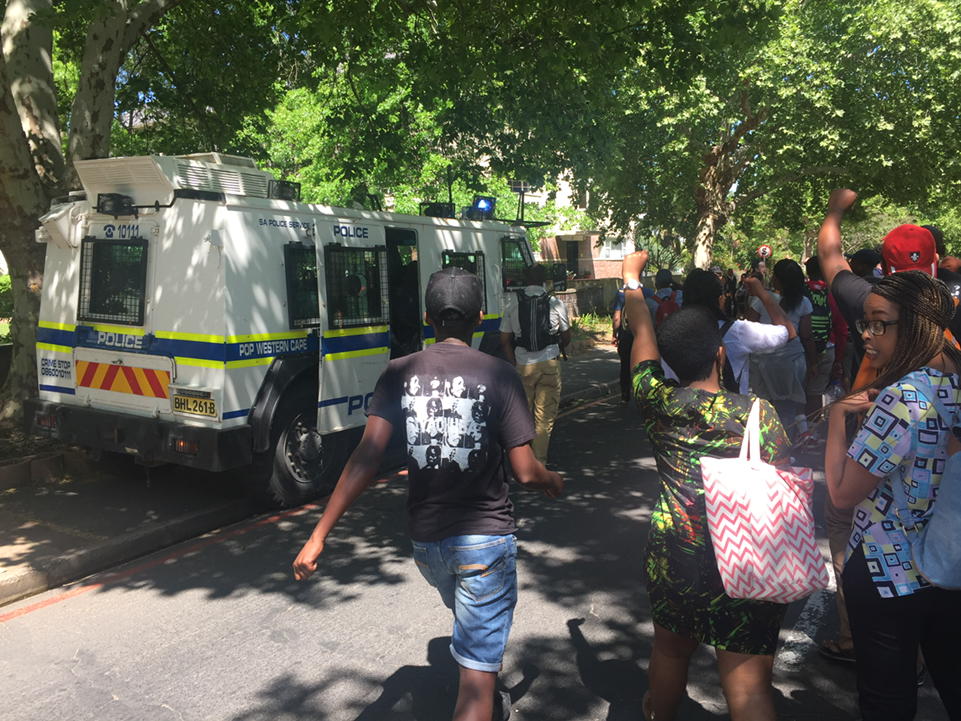
South African students protest for #FeesMustFall: Do I care?

Picture: Adrian de Kock

I didn’t care about the #FeesMustFall...
As bad as that sounds, I didn’t care because I just thought it was another step in the revitalised student protest movement which focused on something inconsequential.
My awareness of the whole student protests started with #RhodesMustFall...obviously I was aware of what happened in 1976 following my 5 years of History in high school, but I did not care about the movement in its current form.
When it started, students were focusing on the Cecil John Rhodes statue, and what it stood for, and throughout my whole four years at UCT, I went by without as much as a clue that this was such a sore point.
It was only following my graduation and subsequent employment did I come to learn that actually this is something monumental.
Many saw the statue as a symbol of oppression and also the fact that the institution that they were studying act created an environment where being white was an advantage. 
Being someone of colour at the university made you feel like you were walking on sacred white ground. It made you feel like you should be grateful to the white people for allowing you to be on it, instead of feeling like you had the right to be there.
This was the very feeling that I got from UCT during my time there, but I didn’t pay that feeling any attention because my main focus was that I going to the Number 1 University in Africa. How lucky was I?
So when the whole movement started to decolonise the University, I understood the student’s point but I couldn’t care about it because the entire conversation became about statues and the whole true message was lost on me.
I guess my upbringing as coconut (coloured/black on the outside, "white" on the inside) did its job. That being said, I don’t regret or have issues with my upbringing because it allowed me to do things that I may not have been able to.
That aside, the whole student movement was just another issue.  
However, the events of the past two days (I was off on Monday), have forced me to sit up and take note.


Since Monday students across the country have been protesting about the proposed raise in their tuition fees. At first thought, you go “Okay, given how expensive life is, it was to be expected that fees would go up to... No big deal.”
And for most of us there is pretty much where the train of thought stops.
However, I was educated and enlightened on Wednesday following an interview that a Cape Times reporter and I did.
They usually say that all it takes is for one person to raise their hand and affect change.
Sascha Egelhof, a student from Stellenbosch University, is that one person for me.
She might not realise it, but she had caused a change within me.
.
The reason why Sascha’s story connected with me is because it made me remember something about myself. I had lived a bit of her story.
When she spoke about:
"...I know that there are other students like me, that don't have the ability to voice their problems. that are almost ashamed of the fact that they are unable to afford their tuition.

Other people who can afford these things, and don't worry about any financial problems are like "oh let's go go, and have a glass of wine." I am like 'oh I can't because I don't have any food in my fridge..." 

It made me think back to my days of being the poor friend and how my friends would pay for me because I couldn’t afford it.
My single parent mother of three boys had to provide rent money, food, electricity, travelling expenses (for her and for me) and also my tuition fees for UCT. For the income of a Personal Assistant to stretch as far as it did was a miracle.
The only way I was able to get through university was because:
  1. I was on financial aid for my entire degree.
  2. I was able to get a boost from a my mother's work bursary in my first year
  3. My mother also had to take out a loan to help with funding and keeping me in university
I didn’t realise how much of a big thing it was because my mother doesn’t like talking about finances and also she wanted me to focus on getting an education. I was ready to get a job but my mother didn’t want that to let it distract from my education.
To this day, my mother us still paying off that loan...and the lack of fees was why I couldn't do my Honours degree actually.
I was able to make it through university and get my degree because my mother was committed to my education, and also because of financial help...but it did not come without financial hardships.
And yet, my story is one of the success stories. I am privileged.
There are many stories from those who have faced similar or greater difficulties than mine. There are hundreds of more stories from those who have been accepted into university but had to drop out because they couldn’t afford the university fees.
When my mother and I was talking about the fact that students across the country and are protesting for the right to education, she started crying because the students who WANT to educate themselves and create better lives for themselves, are unable to because they simply can’t afford it.
All that these kids want it to be able to attend an institution of higher learning and to build lives that their parents (and themselves) have been dreaming of for years. But they can’t.
Why?
Because tuition fees are already leaving the students with crippling debt by the time that they graduate, and now a proposed 11.5% increase in their fees would guarantee that they will never be able to have the education they deserve.

When you are living from hand to mouth like a few of these kids in the Fees Must Fall campaign, fees for tuition can easily become seen as a luxury, and not a need.
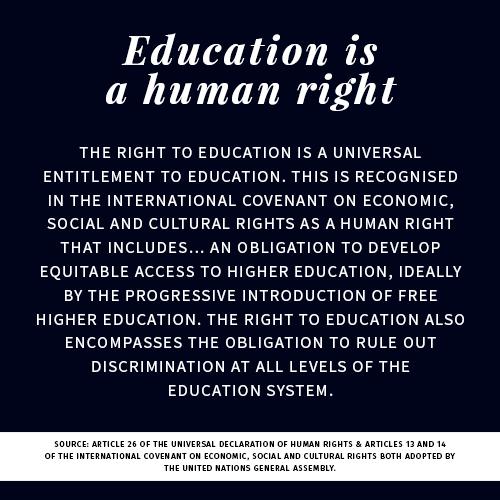
Education shouldn’t be a privilege, it should be a right.


But with this proposed raised, the message from those in higher education is that clearly education should be a right of those who can afford it and not those from the middle and lower classes who want to learn and succeed in life, but don't have the large sums of money to afford it.
The Fees Must Fall movement is the voices of those who come from poor or middle class backgrounds taking a stand saying that education should not be available to only those who can afford it but that it should be available to all regardless of race and class.
Another student from Stellenbosch Khadija Bawa, also made me see the bigger picture when she explained how difficult the situation really is:
We live in country where without a degree from a university or tertiary institution then your options of being able to create a better live for yourself and the future generations is near impossible. It is a common held belief that if you want to become a success then you need to have a university degree, but how are you supposed to do that when you can’t afford to pay for your education?
I saw a post on twitter this week:


The reason why people fought in 1976 was so that their kids could have an education that would allow them to better themselves but yet here we are with a generation of kids who are still fighting for the same battle to get an education.


I care about #FeesMustFall because if I was still at university, I would have been forced to drop out. There is no way my mother would have been able to pay that. I would not have been working in the environment that I am today, and not have had the experiences which have forever shaped my life.
I do have one issue with the movement which is that they want are disrupting other kids from continuing with their education. I understand their frustration because they want their voice to be heard but how many more people are they isolating from their movement because their actions??
It is difficult for me because I find myself split into two minds about this. I know that I would have been studying and preparing for exams because of how important my education was to my mother. Yet this is a necessary action.
That being said, there is this quote that keeps coming back to my mind, the source is believed to be Voltaire, but no one really knows...The quote stuck with me because it suggests that maybe a little disruption is necessary...


I don’t agree with what you say but I will defend to the death your right to say it.
No one can deny that this is huge (possibly revolutionary) movement taking place. The question you have to ask yourself is where you find yourself standing in this movement?
There is no right answer. Only the answer you feel is right for you...

Theo. Over and Out.


Friday, 6 March 2015

5 Reasons Women Must Watch Cricket World Cup

With the 11th ICC Cricket World Cup being hosted by Australia and New Zealand already underway, it is important we rally behind our boytjies and show some of that #ProteaFire. That being said, sometimes the time difference doesn’t encourage us to fully support our team, but sometimes sacrifices need to be made.

So in aid with making our match viewing a little more bearable, I’ve compiled of 5 reasons to watch the Cricket World Cup as the Proteas attempt to win the trophy for the first time:

DAT ASS!!!
  Picture: REUTERS/Vivek Prakash. 

1.       Gratuitous Ass Shots – It’s never really the cameramen’s intention but given how regularly players are running around trying to catch a ball, there are numerous occasions when players’ ass come into view. I say take advantage of that. Wicket keepers especially are always squatting waiting for the moment to catch the ball and so they most likely have the best asses on the field.  It would be a waste not to compare the hard work those men put into obtaining their lovely backsides; that being said, keep an eye out for Captain AB de Villiers who has a stunning toned derriere.

2.       The Touching – These boys really love touching each other whether it is a fist bump, a hug, jumping on one another or lifting each other off the ground, these boys certainly love touching each other and who doesn’t like a guy who’s not scared for male intimacy. Sometimes even if we’re lucky, there might even be a kiss on the temple or head so it’s best to play close attention in case this happens.

3.       The Fans – One might think that this is an odd reason for watching cricket but often it’s the memorable shots of people in the stadium that help make cricket easier to watch. Whether they be wearing silly hats, gone all out to show their support by plastering their entire body in the colour of their teams or just the colourful reactions of fans get caught on camera, it certainly does make for a fun viewing experience. Also since this is a cricket world cup and fans are bound to get caught up in the excitement, be alert in case of streakers.

4.       The Boys – We’ve all heard the saying, different strokes for different folks. Everybody’s taste is different and it is for that very reason why watching cricket is such a joy. There is an endless opportunity for girls, and boys, to perve over a wide variety of men. Whether you like you’re men tall, short, vanilla or dark chocolate the ICC World Cup will cater to your taste.

5.    It’s the right thing to do. Our boys have put in a lot of hard work and are eager to make us proud. Proteas Captain AB De Villiers said, “When we step onto the field, we want nothing more than to make our country proud. We know that we will be representing 60 million passionate South Africans when we head to New Zealand and Australia and having that support means the world to us.” 

With such heart and passion, it’s clear that our boys are ready to win the trophy and it would be such a disservice to them if we don’t show them how much we support them. 

Theo. Over and Out

Saturday, 14 February 2015

Why the dramatic events of SONA were necessary...

Photo Credit: David Harrison, Mail & Guardian.

By now everyone is well aware of what happened in the National Assembly on the 12th of February 2015 when President Jacob Zuma delivered the 15th State of The Nation Address (SONA).

If you’re unaware of the events that took place, here is a summary:

The night was off to a rocky start once news broke of South African Police Services arresting five Democratic Alliance (DA) members outside parliament. Things continued to grow increasingly tense when parliamentary officials and journalists chanted “Bring Back the Signal” - in reference to the jamming device that been activated within the National Assembly thereby interrupting cellular signal. This act was seen as a gross attempt to suppress the views of those present and a violation of the media’s freedom of expression.

The issue was raised and Speaker of the House Baleka Mbete gave, in my opinion, a very inadequate answer by stating, “We’ll look into it.” Not a “we’ll rectify it immediately” but rather “we’ll look into it”. I may be overanalysing her response, but to me, it came off as if she did not realise the implications of the signal being blocked.

If there was ever an attempt to mute the voices of journalists and parliamentary members then this was definitely it.

The DA has to be commended for bringing up the problem in a respectful manner, because it did need to be addressed immediately.

Once the issue was rectified, President Zuma started his state of the nation speech but was rudely interrupted by an Economic Freedom Fighters (EFF) member Godrich Gardee. EFF member after EFF member then continued to bring up the matter of Nkandla asking when Zuma intended to pay back the estimated R246 million of taxpayers’ money that was used to upgrade his private rural home.

EFF party leader, Julius Malema, memorably stated: “You are making a mistake because you are reading my mind” in reply to Mbete’s comment that Malema was not raising a new point of order.

This was disappointing behaviour from the EFF, as it was previously stated within the National Assembly that the president would answer oral questions in parliament on the 11th of March 2015. 
No one is denying that the matter of Nkandla certainly needs to be addressed, but the manner in which it was raised was inappropriate. The National Assembly was informed in advance that the president would answer their questions on a specified date, but yet the EFF still chose to hijack the president’s speech.

Once the party persisted with the subject and made it clear that they were not going to leave it, all chaos broke loose once Mbete called in security personnel to remove the EFF. This was an unprecedented action because never before have unmarked armed men rushed in to remove parliamentary members.

Not only were many EFF members forcefully removed, but they also removed violently. There are numerous pictures showing how battered some EFF members were and how torn their clothes were.

There was nothing respectful in how parliamentary members were removed; it was brutal and degrading.

DA parliamentary leader, Mmusi Maimane, subsequently enquired if the men who rushed in to remove the EFF were in fact police, and stated that the DA would leave if the question was not answered.  The reason for this was because the action is a violation of National Assembly regulations. National Council of Provinces chairwoman, Thandi Modise, who was seated to the right of Mbete, explained that parliamentary protection services were used but that she was unable to distinguish which were police officers and who were not.

The DA then decided to leave parliament.

South Africa has been facing a lot of questions surrounding police brutality and if the security personnel were in fact policemen, which looks to be the case, then this was a prime example of how that issue sorely needs to be addressed. The EFF were wrong to bring up Nkandla but the manner in which they were removed was deplorable and reminiscent of a militia state.

What is the purpose of having police officers if they are as responsible for the violence against South Africans as assault criminals?

This entire course of events happened for an hour, causing a delay of the president’s speech. Throughout the entire time, President Zuma sat quietly watching on but never doing anything to help resolve the issue. Once he got up to speak, he chuckled in response to what happened before starting his speech.

The fact that President Zuma laughed at the events of politicians being aggressively forced out and others conducting a walk out showed a lack of understanding the seriousness of the situation. He came across as detached from the events, and as a president you are meant to be informed of what is happening within National Assembly. Whatever happens in the National Assembly should be of important concern to him but he appeared as if he could not have cared less.

In a snippet from an upcoming TV interview that was broadcast on SABC news, Zuma said that what happened on the 12th of February should have never happened; the rules and regulations of parliament are there for reason and that they should be enforced.

It appeared to me that the president stated this as a way to save face for not being critical or appearing affected by the actions that occurred before his eyes.  

Former President Thabo Mbeki, who was embarrassingly recalled from his position in 2008, slammed President Zuma over the brawl in parliament. He stated that Zuma was wrong to avoid answering questions in parliament. Mbeki believes that Zuma should have directly answered the questions as it would have been the easiest way to deal with the issue and in retrospect I think most would agree with his point.

Maybe there would have been no need for walkouts and violent forceful removals of politicians if President Zuma took a few minutes to answer questions before continuing with his speech?

No one is denying that watching SONA looked comical from a viewer’s perspective but it was very revealing in how the president just sat back as if none of it concerned him.

Now to get to my purpose point of this article-

While the events were completely disheartening and appalling, it needed to happen. The EFF chose the wrong time to bring up Nkandla but it showed how fed up they were, like many South Africans, regarding the situation. Zuma had been playing coy and strategically avoiding answering questions regarding Nkandla for months prior.

Oftentimes as South Africans we are accused of being too complacent and easy to accept the appalling behaviour of our politicians without doing anything. We basically do the Zuma laugh like he did at the start of his speech; continuing on as if nothing is wrong.

There was story last year when the Free State provincial government spent R40 million on a website that cost $40. Now I’m not IT expert but even I know it does not take R40 million to create a website. Once the news broke, South Africans were appalled at how so much money could be wasted instead of being used for other important matters, but it did not take long for the subject  to fade from memory.

R40 million is a huge sum of money and the fact that South Africans were not physically protesting in the streets about the misuse of the money was appalling. I wonder if perhaps it showed our politicians that if they misuse taxpayers’ money then we as South Africans will temporarily moan but it will simmer down with no true action having been taken.

Maybe it is such complacency on our part as citizens that encourage the politicians to behave corruptly because they face little repercussions for it.

The EFF standing up and actively showing their is disapproval regarding the gross misuse of taxpayers’ money and asking if the president intended on repaying that money, was vital; it showed how fed up people were with dubious behaviour from those in power.

South Africans are fed up of bad service delivery, corruption, abuse of power by our politicians, and the manner in which our beautiful country is being run into the ground by politicians who continue to waste money instead of moving this country forward.

We are far from seeing the end of this issue because the ramifications of what happened on the 12th of February 2015 will be dealt with for quite some time to come. Best that we prepare the popcorn, settle in, and watch as the story continues to unfold.

Theo. Over and Out.